
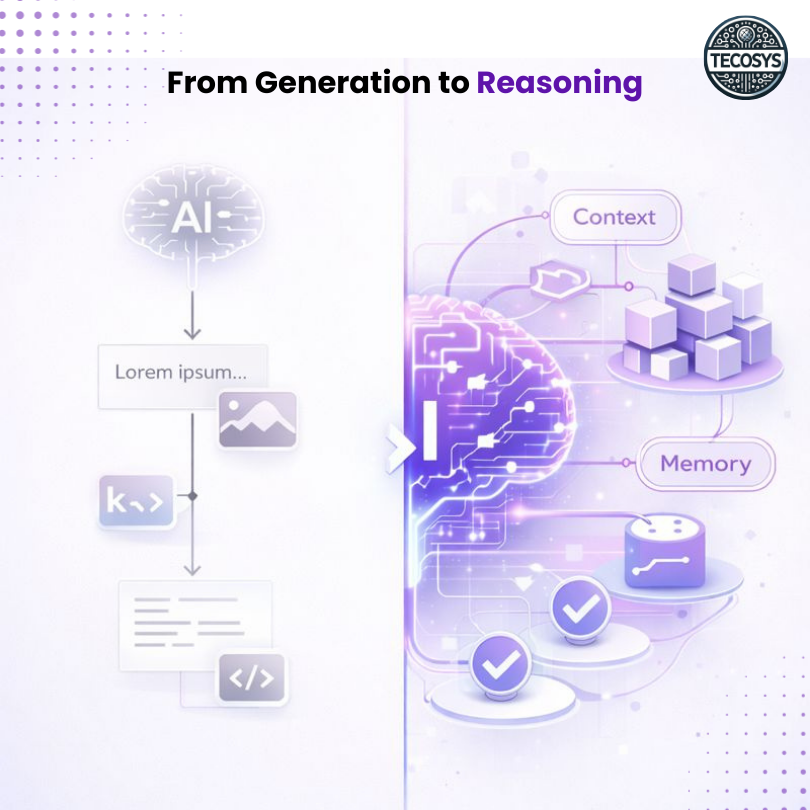
Trend 1: From Generation to Reasoning
As many AI companies have been successful in providing the ability for their software to generate text, pictures and code, this is no longer the only method for AI to be measured in the coming years. In 2026, companies will want their AI systems to have the ability to reason (understand context and make connections with information, retain previous interactions and verify the answer or output produced). AI systems in the future will be expected to generate responses in addition to creating responses.
Trend 2: The Emergence of Embedded AI
As we move toward 2026, more organizations will start to use AI without even thinking about it. Rather than creating an account on yet another AI platform, we will see AI as an integrated feature of our daily systems. At that time, AI will be integrated into CRMs, HR systems, Financial Tools, Healthcare systems, Websites, and Portals.
Trend 3 : Context, Memory, and Domain Intelligence Take Center Stage
A Generic AI model is not designed to be trained for any environment. An example of this would be "legitimate" Health care and "legitimate" E-Commere.
The majority of the companies utilizing AI will be utilizing specific area intelligence to be more efficient and effective than non-domain specific intelligence.
As of 2026, companies utilizing AI for business functions in regulated environments will be utilizing a more efficient means of utilizing AI for their own benefit than Companies utilizing non-domain specific AI.Serializer and the benefits and pitfalls of employing memory within AI will become even more critical — memories create context and remove friction and help reduce the risks associated with AI.
Next-generation technology will not only be "smart," but also able to "think" about what it is doing and who it is doing it for. This means AI will understand (and utilize) the context of an organisation when interpreting spoken and written interactions.
Trend 4: The Emergence of Mandatory Standards for Trust, Transparency, and Compliance With AI
With AI being integrated into most organisational decision-making processes, organisations will soon have no choice but to build trust in the systems used to support their decisions. Governmental agencies and business enterprises will be requiring AI systems to also comply with imperative standards regarding the explanation of their functions and decision-making processes, both ethically and accountable.
So, what's on organisations' minds?
-
Where did the data used to support this decision originate?
-
What was the basis of the decision made by AI?
-
Do we have any means of auditing or challenging the decision made by the AI?
The technology that will shape business in 2026 will not only be measured in intelligence terms, but in corporate responsibility.
Trend 5: AI will move from a cost-relieving device to a revenue-producing engine
AI was first implemented to reduce costs by performing repetitive tasks, improving productivity and making it possible to perform more tasks with less time and resources. AI will, however, no longer be used only for cost-reduction; by 2026, AI will be primarily viewed as a growth engine.
.png)
Businesses will leverage the capabilities of AI systems to create additional leads, more effective sales funnels, customised recommendations, more timely and accurate decision-making and greater conversion of leads into sales. The focus of business will change from “How much money did we save?” to “How much value are we generating?”
The most advanced artificial intelligence technologies available in 2026 won't be about generating more words or having conversations longer than ever before. Instead, it will help companies become more intelligent and efficient at growing faster and smarter.
Trend 6 - Collaboration Between People and AI Will Become the Norm
There is a belief that machines will eventually take over all human jobs. However, this will not happen with respect to a vast majority of critical jobs. The reality is that AI will augment the human's ability to rationalize decisions. By 2026, Human In The Loop models will be used for most things.
The analysis and prediction of behaviours, and the generation of recommendations, will be handled by AI while the person will oversee the AI, use their ethical judgements, provide relevant experiences and make final decisions. This type of collaboration produces better results than either of the individual elements acting independently, and produces lower risk and higher levels of trust for the verdicts that the human made.
Companies who consider AI to be a team member, as opposed to something that replaces them, will have a higher rate of acceptance of AI and will create a better outcome. The companies of the future will be those who learn how to embrace the new way of working with AI.
Trend 7 - AI Governance Moves from Policy to Practice
Artificial Intelligence governance has mainly lived within the documents and presentations so far; By 2026 we expect to see it enter into systems & workflows; therefore, Computers with AI technology will include Computer-Aided Governance capabilities. Computing use cases will include:
• Permission Controls
• Decision Logs
• Audit Trails
• Escalation Paths
The goal is for Companies to build their AI systems to prevent problems rather than react to them after they arise; therefore, the more Companies build Prevention and Proactive Capability into their AI systems through Computer-Aided Governance, the quicker Trust in AI will develop and evolve.
As more Governments begin implementing their own AI regulatory framework, this "practical" Compliance with AI will become a competitive advantage for Companies vs it being an Burden.
The final Trend discussed in this document is related to the increasing willingness of businesses to use ai technology as a decision-making layer or part of the decision-making layer rather than simply being an assistant to answer questions.
Trend 8 - Data Quality Will Be More Important than Model Strength
For years, the focus for companies has been about building bigger and stronger AI models. By 2026, this focus will change. Companies will begin to realize that having clean, relevant, and structured data is more important than having a big model.
Companies with bad data will be making bad decisions regardless of how advanced the AI model is. Therefore, companies will focus a large portion of their budget on data governance, data flow systems, and instant data validation. The evolution of a company to an effective AI will result from companies learning how to properly utilise AI.
Trend 9: AI Becomes a Decision Layer, Not Just an Assistant
AI will transition to being a decision layer that provides guidance on taken actions and prioritizes decisions while still being accountable to the Human Community. AI will evolve from a passive assistant to an active intelligence source.
Utilizing the technology of the future won't simply provide individuals with information; it will also enable individuals to make more informed, accurate, quicker and confidently better decisions.
What This Means for Businesses and Leaders
As discussed above, when businesses and organizations invest in embedding contextualized intelligence, they will establish ongoing competitive advantages over their competitors. Businesses and organizations that continue to chase after excitement with no structure will struggle to grow.
A New Era of Technology will not be about replacing Human Beings or overwhelming current systems. The New Era of Technology will be about developing AI-based technologies that support the goals, values, and responsibilities of Individuals in the Human Community.
AI will not be perceived as being "smarter" just by its use in 2026; but as more "useful," trusted, and essential. The journey from generating to reasoning with AI, from tool-based usage to infrastructure-integrated use, and from automating to intelligence capabilities will represent a new phase for AI.
For everything from building AI to using and leading with AI, it is clear that the "smart" AI of the future will focus on wisdom instead of volume.
Frequently Asked Question (FAQ) :
-
How are artificial intelligence trends changing in 2026?
Moving forward to 2026, the trend (shift) of artificial intelligence will now integrate into more and more everyday life; therefore, we will see three major shifts: AI will now move from generating to reasoning; Companies using AI will now expect greater focus on trust and explainability with AI; AI will now serve as a support layer for companies to leverage for better decisions; AI will shift from primarily being used for automation to intelligence.
As a result of these three shifts, AI will be much more practically reliable, business-ready, and trustworthy for companies.
-
How will AI change how professionals conduct their jobs by 2026?
AI will enhance daily work by creating pathways for companies to directly integrate it into their existing applications. Rather than making employees switch between many different applications, AI will assist employees with task prioritization, risk management, suggestion generation, and decision-making, making day-to-day operations run smoothly and efficiently.
-
Why is reasoning more vital to making real decisions as opposed to simply generating AI content?
The generation of content is helpful, but reasoned judgement plays a critical role in formulating true decisions. Reasoned AI can provide answers based on the history of prior responses to similar queries, contextualize those answers, and explain the rationale for its decisions. In the year 2026, businesses will only trust AI to produce accurate results if the AI can provide a rationale behind its decisions and minimize error.
-
What does it mean to have AI embedded as S/W infrastructure?
AI embedded within an organization’s core systems means that the use of AI throughout an organization has shifted from being a tool or application to a method of operation (aka the tools required to be skilled at using the tools). This shift means that organizations can take advantage of the AI embedded in the tool(s) used by their workforce and customers without needing to actively utilize it. As a result, the use of AI can be scaled more readily as organizations gain confidence that their workforce and customers will utilize these tools consistently and without significant effort.
-
What impact will the development of new technology on in regulated industries look like in 2026?
The development of new technology for regulated industries in 2026 will include designs that are compliant with industry regulations. AI software used in industries (healthcare, banking, government, etc.) will contain embedded compliance controls and audit trails. AI systems will be designed to comply with legal and ethical requirements related to the handling of sensitive information while providing value to users as well.
Discover how your business can move from AI that generates content to AI that reasons, makes smarter decisions, and drives growth.
Learn more about Tecosys’ intelligent AI solutions: Tecosys AI